The Midweek #87: The Vote that Saved CPS Energy
The City of San Antonio and CPS Energy ratepayers are among the big winners in the Nov. 3 election, which swept the state’s Republican leadership from office after a three-decade chokehold on single-party governance.
Gov. Greg Abbott attacked the utility’s market dominance during an Aug. 4 appearance at the home of a San Antonio ratepayer, calling it “a monopoly” and falsely declaring that opening the market to investor-owned energy companies would give ratepayers lower monthly bills. Opponents saw Abbott doing the bidding of deep-pocketed donors who coveted access to the growing market.
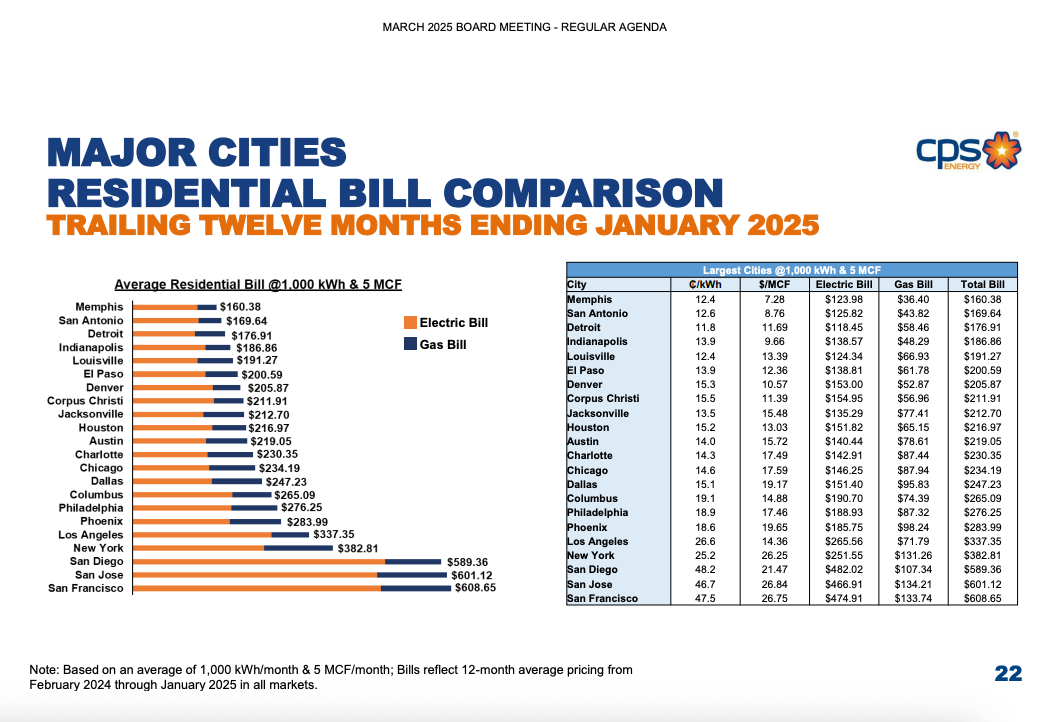
At a March 2025 board meeting, CPS Energy staff presented a study comparing the average residential utility bill in 23 U.S. cities. San Antonio ranked second for affordability, behind only Memphis. El Paso, Corpus Christi, Houston, Austin and Dallas all ranked lower in the survey. No other large Texas city ranked better than CPS Energy.
More than residential and commercial electric and gas rates was at stake. Visionary city leaders purchased the San Antonio Public Service Company, a privately owned utility, for $34 million in 1942 and renamed it City Public Service. It was renamed again in 2003, and today, CPS Energy is the country’s largest municipally owned electric and natural gas utility.
Agreements directing revenue payments to the city varied between 1942 and 1987, but since then, up to 14% of gross utility revenues, subject to availability and other obligations, has been paid by CPS Energy into the City of San Antonio’s general fund. A recent CPS Energy report placed the total paid to date at $10.6 billion. The city’s fiscal 2027 budget anticipates a $547.8 million contribution from CPS Energy, about 31% of the general fund and more than either property or sales tax revenue.
In sum, the San Antonio city government and services we know today simply would not exist if civic and business leaders had not had the vision to establish the municipal utility as a public service. Abbott’s threat, if successful, would have crippled local government.
That threat is now gone, and there is an opportunity to reverse ERCOT’s ill-advised $2.5 billion Howard-Solstice 765-kV transmission line, set to run 370 miles through 14 Texas counties, from a CPS Energy substation in southwest Bexar County to Fort Stockton, as part of the state’s Permian Basin Reliability Plan. Amid growing bipartisan opposition, the state’s Public Utility Commission approved the line’s route in September, clearing CPS Energy and AEP Texas to build it and bring it into service by 2030 to provide additional power to oil and gas operations and to companies seeking to build massive data centers in West Texas.
I recently spoke to one of the people who helped organize opposition to the plan among mostly Republican ranchers and landowners along the route, through the Texas Hill Country and sensitive Southwest Texas river basins. “The state was forcing CPS Energy to run an extension cord from its San Antonio base to far West Texas,” that person said, expressing frustration with ERCOT and the PUC.
A number of Republican legislators who voted for ERCOT’s plan have since said they did not understand the full dimensions of the proposed high-voltage transmission lines, which sounds like they voted for a bill they had not bothered to read. That should make a challenge easier to undertake, with Republicans controlling the Texas Senate and Democrats controlling the Texas House.
Two questions worth asking in any future debate: Why allow sparsely populated West Texas, with its water scarcity and lack of public infrastructure, to become a magnet for data center builders and other energy-hungry operators? Why can’t the oil and gas industry stop its polluting practice of burning off methane and harness that energy to fuel its existing operations in the Permian Basin?
ERCOT has not addressed the fact that El Paso is about 70 miles closer to Fort Stockton than San Antonio is, and is connected to the Western Interconnection, the grid that serves much of the western United States and Canada. If market competition is the name of the game, why not solicit bids from investor-owned El Paso Electric?
The political and public policy conversations between now and year’s end will focus on how the stunning election results will change the balance of power and the agenda in Texas in the legislative session that opens in January.
Common sense, good governance and sound fiscal and environmental policies should define this once-in-a-generation opportunity for officeholders now that voters have restored two-party governance in the state.

Host, bigcitysmalltown
Robert “Bob” Rivard is a veteran American journalist whose 46-year career has taken him across Texas, Latin America, and beyond. He co-founded the Rivard Report (later named the San Antonio Report) with his wife, Monika Maeckle, in 2012, building it into the city’s leading nonprofit news organization before retiring in 2022.
Bob has worked for five Texas newspapers, beginning his career on the border at the Brownsville Herald, then moving to the Corpus Christi Caller, the Dallas Times-Herald, and later serving as a foreign correspondent and chief of correspondents for Newsweek. He returned to Texas as senior editor of the San Antonio Light before becoming executive editor of the San Antonio Express-News (1997–2011).
His journalism has earned widespread recognition, including being named Editor & Publisher’s “Editor of the Year” in 2000 and receiving the prestigious Maria Moors Cabot Award from Columbia University for his reporting on Latin America and the U.S.-Mexico border.
He is the author of Trail of Feathers, a nonfiction book chronicling the disappearance and murder of journalist Philip True in Mexico’s Sierra Madre. The book, published by Public Affairs in 2005, was widely reviewed, excerpted in Esquire, and selected by People magazine as one of five recommended nonfiction works that year.
Bob now hosts bigcitysmalltown, a podcast featuring the people shaping San Antonio’s future. He and Monika live in Southtown, where she runs the Texas Butterfly Ranch blog and previously founded the annual San Antonio Monarch Butterfly and Pol… Read More


