The Midweek #74: Amid a $158 Million Deficit in the City's 2027 Budget, Mayor Jones Targets Nonprofits
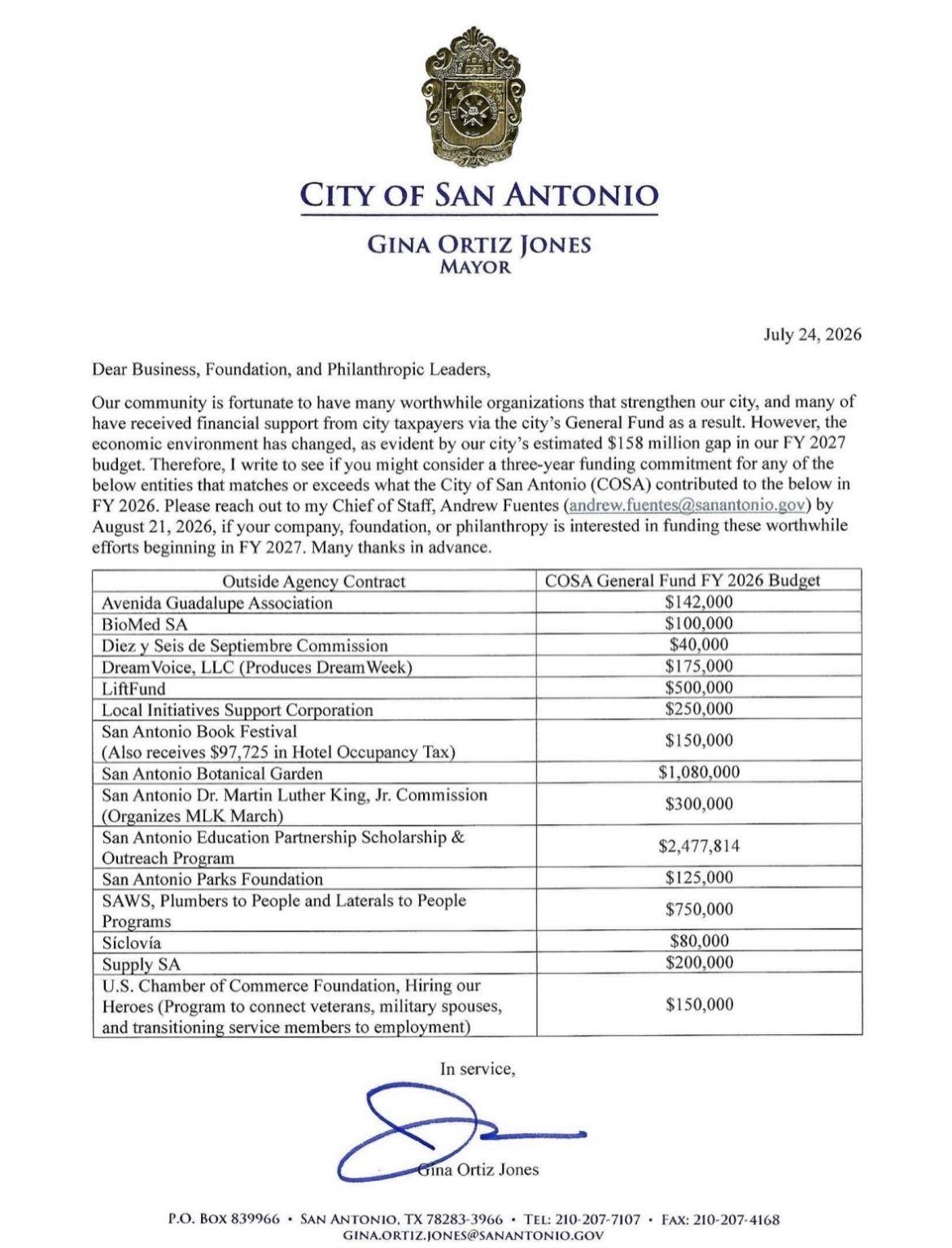
Mayor Gina Jones has sent a July 24 letter to San Antonio's business, foundation, and philanthropic leaders asking for new, three-year funding commitments to allow city budget cutters to eliminate $6.5 million in annual grants to 15 mostly local nonprofit organizations that enjoy “line item” status in the annual General Fund.
City Manager Erik Walsh and team are working now on the fiscal 2027 budget with its projected $158 million deficit, brought on by declining real estate values and reduced sales tax revenues. He is expected to recommend a range of spending cuts and a property tax increase, the first in more than two decades.
Walsh will present the proposed budget at what promises to be a closely watched August 13th meeting, giving the mayor and council members one month to propose alternatives before a September 18th final vote. The new budget goes into effect on October 1st.
If you are behind on this news, you can read this week’s article in the San Antonio Report and start your subscription to Philip Reichert’s The Civic, an important new voice in the city.
Mayor Jones did not win the election with support from the business community or many of the leading philanthropists in the city, and there is a real question about what kind of support she will find now. City staff’s proposed cuts might not align with the mayor’s initiative.
Interestingly, Mayor Jones has not proposed similar budget cuts for the city’s Arts & Culture Department and its annual grants to organizations and individuals that total $7.7 million in the 2026 budget. The money for these grants comes from a dedicated 15% of Hotel Occupancy Tax collections. Eliminating city funding here would require the mayor to target the Esperanza Peace & Justice Center, the prominent Westside nonprofit that combines community art workshops, LGBTQ advocacy and organized protest campaigns against urban development it opposes.
In any case, I doubt the mayor has built the necessary goodwill with the individuals and foundations that received her letter. I spoke with several who would only speak on background to avoid antagonizing Mayor Jones. None indicated they were rallying to the mayor’s cause, although they might direct funding to nonprofits that lose city support. The mayor is not wrong to question every non-essential spending practice, a routine exercise in private sector budgeting, but she could find her lack of bridge building with the business community during her first year in elected office will cost her here.
You can see a full list of the 15 nonprofits cited by the mayor in her letter, but they include the nearly $2.5 million allocated annually to the San Antonio Education Partnership, $1.1 million for the San Antonio Botanical Garden, $750,000 to SAWS for its Plumbers to People program, $500,000 for LiftFund, and a number of well-known and lesser-known nonprofits receiving annual grants that range from $250,000 down to $40,000.
Even regular city hall watchers might be surprised by a few of the recipients. Why does the city give the U.S. Chamber of Commerce’s charitable foundation, a Washington-based lobbying organization with deep pockets, $150,000 a year to provide veterans with services? Another $200,000 is paid annually to Supply SA, which connects veterans in small companies to public procurement opportunities. Why does the national Local Initiatives Support Corporation receive $250,000 every year for its local operations?
Why give SAWS, the municipal water utility, any such support? SAWS CEO Robert Puente could cover much of the funding by smartly redirecting the $132,000 bonus he received this year.
The $158 million deficit represents 9.3% of the $1.69 billion General Fund forecast in the city’s five-year financial forecast, although the deficit is projected over a longer period. An improving economy would lessen the number. Given that more than half the General Fund is allocated to police and fire, and another 30% or so to the city’s civilian workforce, there isn’t a lot left to fight over after addressing the basics, like streets, parks, and libraries.
I’m not sure why the mayor initially singled out the Botanical Garden in her earlier call for cuts to nonprofits included in the General Fund. Perhaps she believes the 41 acres of botanical diversity located near Brackenridge Park and Fort Sam Houston principally serve wealthier residents in the adjacent municipalities of Alamo Heights and Terrill Hills. The Botanical Garden's lack of regularly scheduled free admission days might be a factor.
One such organization that receives an annual grant is the Briscoe Western Art Museum, which received $154,000 in 2026.
My wife Monika Maeckle and I attended last Saturday’s annual National Day of the Cowboy or Día Nacional del Vaquero event at the museum, where we are members. Saturday’s festivities were free and open to the public. The profile of the regular museum patron compared to those attending the free admission events was immediately obvious. Hundreds of local working-class parents and their children in attendance reminded me of how much it means to the city for museums and other institutions to serve families who cannot afford the luxury of paid memberships.
City funding for all such organizations should include a mandate for regularly scheduled free admission days or evenings. The Briscoe opens its doors to the public on the first Sunday of every month, so free admission on August 2nd is right around the corner.
Inside the museum, the third floor was shoulder-to-shoulder with families taking in Tejano Legacy: Another American Origin Story, the museum’s biggest exhibition to date in its 13 years of operations on Market Street and the Paseo del Rio. Children crowded around craft tables where docents led hands-on learning projects. The bilingual exhibit covers 400 years of Tejano history in San Antonio and South Texas and serves as a reminder of how deeply entwined our city’s history is with Spain and Mexico.
The Briscoe, the San Antonio Art Museum, the McNay Art Museum, the Witte Museum, the Doseum, and Centro de Artes, among others, offer free admission days. The Alamo and the San Antonio Missions National Historical Park offer free admission year-round.
I am not taking the customary “cut others, but don’t cut me” approach to defending existing budget allocations to nonprofits and arts organizations. These recipients, however, often are the first targets of budget cutters who might lack an appreciation for the services they deliver. Given the mayor’s focus on working-class San Antonians, she should appreciate the impact organizations have that offer free admission on a regular basis to families that cannot afford the luxury of a museum membership.
It’s certainly easier to cut third party funding recipients than it is to walk down the hall to tell a department head they can’t fill vacant positions. Yet a city with 13,723 authorized full-time and part-time positions in its 2026 budget ought to be able to cut staff before it cuts programs and services. I won’t advocate for a reduction in force, but I would say a workforce of that size must include vacancies that can remain unfilled for a year or more. Using such attrition to reduce the deficit might mean more work for some who continue to enjoy job security, but it’s preferable to buyouts and layoffs.
Public town halls on the city budget are scheduled throughout the 10 council districts between August 17 and 28. These hearings are the best opportunity for individuals to express their opinions on the budget. Work sessions and departmental briefings will continue through mid-September until the final vote on September 18th.

Host, bigcitysmalltown
Robert “Bob” Rivard is a veteran American journalist whose 46-year career has taken him across Texas, Latin America, and beyond. He co-founded the Rivard Report (later named the San Antonio Report) with his wife, Monika Maeckle, in 2012, building it into the city’s leading nonprofit news organization before retiring in 2022.
Bob has worked for five Texas newspapers, beginning his career on the border at the Brownsville Herald, then moving to the Corpus Christi Caller, the Dallas Times-Herald, and later serving as a foreign correspondent and chief of correspondents for Newsweek. He returned to Texas as senior editor of the San Antonio Light before becoming executive editor of the San Antonio Express-News (1997–2011).
His journalism has earned widespread recognition, including being named Editor & Publisher’s “Editor of the Year” in 2000 and receiving the prestigious Maria Moors Cabot Award from Columbia University for his reporting on Latin America and the U.S.-Mexico border.
He is the author of Trail of Feathers, a nonfiction book chronicling the disappearance and murder of journalist Philip True in Mexico’s Sierra Madre. The book, published by Public Affairs in 2005, was widely reviewed, excerpted in Esquire, and selected by People magazine as one of five recommended nonfiction works that year.
Bob now hosts bigcitysmalltown, a podcast featuring the people shaping San Antonio’s future. He and Monika live in Southtown, where she runs the Texas Butterfly Ranch blog and previously founded the annual San Antonio Monarch Butterfly and Pol… Read More