150. The Rise of Jamaican Food in San Antonio (ft. The Jerk Shack)


This week on bigcitysmalltown, we sit down with Chef Nicola Blaque, the force behind San Antonio’s only Michelin-recognized Jamaican restaurant, The Jerk Shack. Chef Nicola shares her journey from immigrating to the U.S. as a child, navigating life in New England, and serving in the Army through three tours, to eventually reclaiming and expressing her Jamaican heritage through food in San Antonio.
Host Cory Ames joins Nicola in the restaurant to discuss how her identity, family, and military experiences have shaped her work—along with the challenges of introducing authentic Caribbean cuisine to the city. They examine the evolution of San Antonio’s food culture, its openness to new flavors, and the collaborative spirit found among local chefs.
Topics include:
• Bridging cultures and reclaiming identity through food
• The transition from military service to entrepreneurship
• The realities of building a restaurant in San Antonio—including obstacles, opportunity, and community support
• The role of local chef collaboration in fostering a diverse food ecosystem
• Reflections on parenthood, legacy, and the future for Black and Caribbean cuisine in Texas
The episode offers a candid look at Chef Nicola’s path, the resilience needed to thrive in an ever-changing city, and what the next chapter might hold for San Antonio’s culinary landscape.
RECOMMENDED NEXT LISTEN:
▶️ #83. Chris Cullum and San Antonio's Culinary Legacy – Discover how Chris Cullum, chef-owner of Cullum’s Attaboy and James Beard finalist, draws on family heritage and jazz roots to shape San Antonio’s vibrant dining scene. Host Bob Rivard explores the challenges of sustaining culinary innovation while honoring tradition—perfect for listeners inspired by Chef Nicola Blaque’s journey of identity and authenticity.
-- --
CONNECT
SPONSORS
🙌 Support the show & see our sponsors
THANK YOU
⭐ Leave a review on Apple Podcasts
⭐ Rate us on Spotify
Cory Ames [00:00:03]:
Welcome to bigcitysmalltown. The show about the people who make San Antonio go grow. San Antonio, or Texas for that matter, has only one Michelin recognized Jamaican restaurant, and it was created by a chef who refused to water anything down. You might have seen Chef Nicola Black on Guy Fieri's Diners Drive Ins and Dives. Or if you're lucky, you might already know the Jerk Shack, which earned acclaim seemingly overnight. But today, we're going to go deeper into a story of identity, into the experience of losing and reclaiming culture, into the chef's years in the army, and into what it meant to bring authentic Jamaican food to a city that wasn't sure it was ready for it. Before we get in today's story, just a quick note. I had the pleasure of recording this episode in Inside the Jerk Shack with Chef Nicola Black.
Cory Ames [00:00:54]:
All right, y', all, I'm your host today, cory ames. Let's get into this story.
Cory Ames [00:01:06]:
What do you think people are maybe most surprised about when they sit down with you and chat? The awards, the accomplishments, the background?
Nicola Blaque [00:01:14]:
Just my life. Yeah. For one, I'm an immigrant. You know, I came to the US When I was five. My mom and my dad, they're from Jamaica, but I came here to live with my mom, my stepdad, who's also from Jamaica. And at the time, you know, I moved to Portsmouth, New Hampshire. And I don't know if you're familiar with Portsmouth, New Hampshire, but there's not a lot of people that look like me. And then coming with a very strong Caribbean accent.
Nicola Blaque [00:01:50]:
And life is just kind of life in and rough very early on. Just me being here in the US and my stepdad being in the Air Force, us moving every couple years, it made it really hard for me to, like, connect with my Jamaican culture, connect with friends, connect with family. And so I think pretty much from 5 to 18, I really struggled with my identity and, like, who I wanted to be and who I wanted to be around. And I joined the army. And the only thing when I was in the army that I really felt like truly connected me to myself or my family or anything was food. And so, yeah, I think when I share that with people, they. They assume that I've worked in restaurants and I've been around all this food, and it's like, really, I haven't. You know, it's just the one thing that kind of kept me whole throughout all of this and then joining the army, going to war three times.
Nicola Blaque [00:03:02]:
Yeah. You know, and then starting a restaurant that I've never done before.
Cory Ames [00:03:08]:
So does that feel like the same person? Person who went to war three times?
Nicola Blaque [00:03:14]:
Listen, I'm a mom now, and none of that feels the same, you know, like, it's, it's. It's a weird feeling because it's like you don't know that life evolves so much over time. You know, you don't think that, you know, one day you're going to be in a bunker praying that this rocket doesn't hit you to the next time you're taking care of an adult, a little baby. Like, I don't know this, but I have to keep you alive. And I've got employees that depend on me and their family is depending on me. And. Yeah, it's like you're the same person, but in different lives.
Cory Ames [00:03:55]:
Yeah. And it's. It seems like it's an obsession of humans to make comparisons, to try and see, like, is this like the experience.
Nicola Blaque [00:04:03]:
That I was having before or how many people are having the same experience like you. Yeah. You know, right now, like, I'm looking at the food bank thing. I'm like, you know, I. I look at life and I'm like, are we all in the same life? You know, like, how are we struggling with people needing food? And I own a restaurant. Like, that's crazy. You know, like, there's. We shouldn't be like that in life right now.
Nicola Blaque [00:04:31]:
You know, I watched something the other day and it was on a small town. Mr. Beast, he's got me right now, but he's doing things like just creating clean water for different countries and villages. And I'm just like, how are we in the same world where there's people struggling for clean water and us having water so freely? Like, how are we in the same world? I don't. So, yeah, it's.
Cory Ames [00:05:04]:
Yeah, it's a, It's a constant paradox, especially in the context of restaurants and food waste. And it seems like that absolutely should exist.
Nicola Blaque [00:05:14]:
Yeah.
Cory Ames [00:05:15]:
But maybe, maybe along the lines of things that. That are hard to reconcile, you very quickly seems earned a lot of awards and recognition.
Nicola Blaque [00:05:23]:
Yeah.
Cory Ames [00:05:24]:
With. With your work to starting the dirt shack only in 2018.
Nicola Blaque [00:05:29]:
Yeah.
Cory Ames [00:05:29]:
Right. Perhaps of all that be it the awards, the recognition for opening of the new restaurants. I know now freight will also be in the new airport terminal. Coming up. What's most surprised you personally?
Nicola Blaque [00:05:42]:
Do you feel the biggest surprise of all of this is that it's happening to me like I said, I got out the Army 2013. You know, I didn't start culinary school until 2014, 2015. I didn't have a playbook for any of this. You know, I'm literally just watching chefs and picking up small bits and, you know, just. Just moving and navigating and, you know, I. I moved so blindly in a lot of decisions that I made, because who do you ask? Who do you. You know, like, I don't know anyone else who has a bigcitysmalltown restaurant, like my restaurant, serving the food that I want to serve. And, you know, like, I'm doing this without any knowledge, you know, and it's surprising that I'm doing and people like it, and it's.
Nicola Blaque [00:06:41]:
It's taking off, you know?
Cory Ames [00:06:44]:
Well, I mean, you say blindly, but it seems like you. You maybe still act with a lot of conviction, at least that's.
Nicola Blaque [00:06:50]:
I. When I started, I just keep going, you know, because I owe it to myself. But I also, you know, I have my team. Like, when I. When I talk about my team, it's not just because they work for me and they're great employees, but they believed in a lot of the things that I come up with. It might not make sense initially, but they believe in it, and they follow through with my vision. And I think that's really important, you know, to have that. That support system that.
Nicola Blaque [00:07:26]:
That cushion that says, okay, cory, that's what you want to do next. Like, let's try that. Let's go, and let's really push the limits. And, you know, I don't. I don't think any of all this, you know, would have happened without some bigcitysmalltown members, so.
Cory Ames [00:07:43]:
Well, and I imagine that people are very inspired by what. What seems like a sense of mission in prize. And from what I could gather as I prepped for this, you seem to be someone who's interested in doing something not just because it's, you know, lucrative or profitable. You're doing it because it's important.
Nicola Blaque [00:08:00]:
Yes. Yeah. Where.
Cory Ames [00:08:02]:
Where does that come from? Is that, you know, family influence? Is that, you know, time spent in.
Nicola Blaque [00:08:07]:
The military, A little bit of everything. Like being an immigrant, being different, being, you know, like. You see, what the. Like, the same way that I came to the states in the 80s, that's what it felt like, you know, being different. You were made fun of. You were treated badly. You know, I have a nut allergy, and when I was little, the babysitter only gave me peanut butter sandwiches, and, you know, like.
Cory Ames [00:08:37]:
Yeah, it's little things like that that, you know, I think it made me want to fight, you know, like being in the military. Like I said, you know, I was going to war at 18, 19, not having any knowledge of really what life is. But I signed myself up into the army just hoping for a better future, not knowing I'm going to war and having to have the mental toughness to make it through that and know like there is life after, even after two more times being deployed, like that's rough. You know, being out now and seeing how many people are truly disconnected with the military and what they do on a day to day basis, I feel like I'm really blessed. I'm really blessed to be able to have another life after the military and to bring it to such, you know, dreams. Yeah, that's, it's, it's unbelievable. I'm really blessed to be able to have another life after the military and to bring it to such, you know, dreams.
Nicola Blaque [00:08:40]:
Yeah, it's little things like that that, you know, I think it made me want to fight, you know, like being in the military. Like I said, you know, I was going to war at 18, 19, not having any knowledge of really what life is. But I signed myself up into the army just hoping for a better future, not knowing I'm going to war and having to have the mental toughness to make it through that and know like there is life after, even after two more times being deployed, like that's rough. You know, being out now and seeing how many people are truly disconnected with the military and what they do on a day to day basis, I feel like I'm really blessed. I'm really blessed to be able to have another life after the military and to bring it to such, you know, dreams. Yeah, that's, it's, it's unbelievable.
Cory Ames [00:09:45]:
Well, and what I caught too, in my due diligence is that that period between the military and then deciding to attend the CIA, the culinary Institute here in San Antonio was a little bit of sorting through, you know, that challenging period of what you do next.
Nicola Blaque [00:10:01]:
Yeah.
Cory Ames [00:10:02]:
And that's something I'm sure that many folks in the San Antonio area, being Military City USA can certainly resonate with that challenge.
Nicola Blaque [00:10:09]:
And you know, I had a little more freedom. You know, I didn't have kids at the time, just my stepson who was in elementary going to middle at the time. And so even then I still didn't have a lot of knowledge of parenting and basically just keeping this little human alive and taking them to school and everything else.
Cory Ames [00:10:30]:
Yeah.
Nicola Blaque [00:10:31]:
But I had freedom to make decisions like that, you know, like I moved from Hawaii to here in under six months. You know, I can't say that the average person, if they need to make a decision like that, they can move so freely.
Cory Ames [00:10:52]:
Yeah.
Nicola Blaque [00:10:53]:
You know, like what I was able to do was truly like a blessing to be able to just be like, yep, this is what I'm doing now, you know, and even with opening this bigcitysmalltown, I knew like I wasn't going to survive at the old jerk shack. I just knew it, like I felt it every day and I was just like, I need to come up with a better plan. You know, fre transitioning to freight. I had me roti, which is this concept near and dear to me and it wasn't working. It wasn't working. And I knew like, I have to think of something that is going to work, that's going to be approachable, that's going to open me up to, you know, people that want to try my food and, and, and go down this road with me. And, you know, and. And that's just what I've been able to do.
Nicola Blaque [00:11:45]:
You know, I've been very blessed to be able to make those transitions, but also see the writing when it's on the wall.
Cory Ames [00:11:52]:
Yeah.
Nicola Blaque [00:11:52]:
You know, hopefully that. That. That maintains.
Cory Ames [00:11:56]:
I'm sure it will. I'm sure it will. And maybe along those lines, I. I know San Antonio is not. Not exactly home.
Nicola Blaque [00:12:03]:
Yes.
Cory Ames [00:12:04]:
But you've been here over a decade.
Nicola Blaque [00:12:06]:
Yep. You've started your restaurants and your businesses.
Cory Ames [00:12:09]:
You got a couple young kids here.
Nicola Blaque [00:12:11]:
Y.
Cory Ames [00:12:13]:
How welcoming do you feel like San Antonio was to the concepts of the restaurants?
Nicola Blaque [00:12:17]:
But where I look at where we're at right now and what's happening with Caribbean food, I feel like it's an evolution, and I kind of just, like, stirred the pot a little bit, and now it's, like, blooming, you know, like, you've got bigcitysmalltown, who is in Houston, and they were in the Michelin guide, best new restaurant in.
Nicola Blaque [00:13:15]:
In on Forbes list, and they just hit another list, and I'm just like, man, like, what I was doing, what I felt like there were other chefs feeling like it. There are other people from the Caribbean and Africa that felt what I'm feeling.
Cory Ames [00:13:31]:
Yeah.
Nicola Blaque [00:13:32]:
You know, I wasn't alone in that, and I'm glad, like, I stuck to my guts and to really put this out, because I feel like it only contributed to the greatness that's out there today.
Cory Ames [00:13:42]:
Yeah. Well, maybe tactically, I'm interested to hear, like, what was particularly or has been particularly challenging in the ecosystem of San Antonio? Because from my vantage, I think that your success story is one that we want replicated in San Antonio, you know, food that we can lay claim to here in our city, pushing our food scene forward in the success of your business as well, coupled with that, like, what does San Antonio do particularly well and what maybe were areas in which you'd hope for, you know, chefs in your position where friction is reduced or things are made easy?
Nicola Blaque [00:14:21]:
Well, one, I think San Antonio has the best group of chefs. I. You know, it's very few chefs in the city that I'm going to just say all of them. Every chef that I've ever came across with has been more than pleasant to me, but also very helpful, very collaborative. You know, just. It's a positive environment where I've heard from other cities, from other chefs, like, what you're doing here with these chefs, we can't do that in our city. City, you know, and we're just. We're just nice to each other, you know, and so I think that we do that really well.
Nicola Blaque [00:15:05]:
All the chefs where I think that we can work on is San Antonio is so new to diverse cultures, and it's like we have to get out of what we're used to and open our minds to something new or evolved or. Or elevated. We need to get to that space, because if we can get to that space, I think that we can get more chefs to create rather than be there to just fulfill a need.
Cory Ames [00:15:47]:
Well, what do you think that looks like?
Nicola Blaque [00:15:50]:
We're sitting in almost 3,000 square square feet. Right. I once read a book on density. Right. And it talked about how everyone in communities will thrive if we all just take a little bit. We don't need all of this. Like, what if it was, you know, more smaller spaces, like it is in other countries, where we can go and you can have coffee here, but you get your baked goods here, and we're. It's not so much like coffee, baked goods, once spot, like how it is here.
Cory Ames [00:16:21]:
Yeah.
Nicola Blaque [00:16:21]:
But it's more smaller, collaborative spaces that really make the community thrive.
Cory Ames [00:16:27]:
Yeah.
Nicola Blaque [00:16:27]:
And I think that's one thing that we should start doing here in bigcitysmalltown. You know, we're at the Pearl, and I love that there's so many other restaurants there, because I feel like we all help each other and we're not stepping on anyone's toes. When I started frying chicken here at Jerk Shackles, I talked with Jeff Balfour of Southerly on what I was thinking, you know, and it's like, you know, like, we help each other, and we can still create something great together, but I think if we all had just more options to be together, I think we would thrive as a whole, as a city. That's my thoughts.
Cory Ames [00:17:13]:
I totally agree. I think there's a reason that the Pearl is so popular, is that there's a lot of demand for that type of spot. You know, it's something in which people can walk around. It's not just one place that they Go to. And then that's the end of the experience. It's something that you can, you know, pass time. Plazas, essentially. Yes.
Nicola Blaque [00:17:31]:
Walkability.
Cory Ames [00:17:32]:
Yeah. And. Well, and then there's the difficult thing of if you want to be in a walkable zone, obviously the, the rent or the lease on the building that you're occupying is going to be vastly more expensive.
Nicola Blaque [00:17:42]:
Yep.
Cory Ames [00:17:42]:
So there's the difficult dance, I imagine, for many restaurant chef owners.
Nicola Blaque [00:17:47]:
Yeah. Deciding where to be affordability, you know, and it's like, okay, yes, I can afford it, but will my customers come to that place? You know, when I started off at the old jerk shack, I think I was pretty naive because I really didn't have a full understanding of bigcitysmalltown. I really just needed to get into a small space to, to start catering, to start continuing my business. And then it just like life happened to me and I was like, okay, this is what I need to be doing next, you know? But I, I, I still, when the doors open in my mind, I was like, I'm going to have customers every day. Like, I never knew any differently. And I know people that have opened up in parts of bigcitysmalltown where they were not that fortunate.
Cory Ames [00:18:41]:
Yeah.
Nicola Blaque [00:18:42]:
You know, and so I think creating spaces where they don't have to question that, you know, it's like, no, there's a nice pocket here. There's another pocket here. Like, we need more of that.
Cory Ames [00:18:56]:
Yeah. Well. And to reiterate that point, it's in all of ours interests to have a more interesting, more compelling, more diverse food scene. And it's reassuring for me to know from the outside looking in that chefs in town are more collaborative than they are competitive.
Nicola Blaque [00:19:12]:
Oh, yeah.
Cory Ames [00:19:12]:
And I like that. Generally about San Antonio, I hear the same thing. This is not home for me either. Although I've been here almost 10 years.
Nicola Blaque [00:19:18]:
Okay. Where'd you come from?
Cory Ames [00:19:20]:
From Spokane, Washington.
Nicola Blaque [00:19:21]:
Oh, my gosh. That just gave me chills. My stepdad was stationed.
Cory Ames [00:19:26]:
Fairchild.
Nicola Blaque [00:19:26]:
Yes.
Cory Ames [00:19:27]:
All right.
Nicola Blaque [00:19:28]:
Yeah. Oh, my God. So another people do not know that. Yeah. You know, like, whenever I say Spokane, they're like, where? I'm like, no. And the one thing that I remember. So I was there for a while. Yeah.
Nicola Blaque [00:19:38]:
Middle school, two years. Yeah.
Cory Ames [00:19:40]:
What middle school did you go to?
Nicola Blaque [00:19:41]:
I don't even. That's what I lived, like, right up the street from Gonzaga University.
Cory Ames [00:19:48]:
That's where I went to school.
Nicola Blaque [00:19:49]:
Okay. Yeah.
Cory Ames [00:19:50]:
That's crazy.
Nicola Blaque [00:19:51]:
Yeah. We were right up the street from there.
Cory Ames [00:19:53]:
Wow. Yeah, man. That's nuts.
Nicola Blaque [00:19:55]:
That's crazy.
Cory Ames [00:19:56]:
Might as well have been Canada.
Nicola Blaque [00:19:58]:
Yeah. And then what's the other side? Idaho was like.
Cory Ames [00:20:01]:
Idaho's right there.
Nicola Blaque [00:20:02]:
Yeah. Yeah. Wow. Two years. Two years. Okay, well. So, yeah, you could see my life, all these random places that I've lived, and it's like, some of it. The food, like, I lived in Hawaii for a long time, and I love Hawaiian food, but I love, like, the flavors of it, and I wanted to incorporate that into jerk shag.
Nicola Blaque [00:20:26]:
And. So is it authentic? No, but it's authentically for me, you know, like, I'm putting out flavors that I love, you know, and. And I'm Jamaican, and I think early on, some people kind of struggled with what that looks like. But here we are now in 2025, and people are just finding out that there is a whole Chinese cop population in Jamaica and rice came to the Caribbean from the Chinese. You know, like, it's having. Having those stories, having that knowledge to like, really put it out there to kind of help people understand. And I think our success was not just from me standing strong with what I wanted, but being able to share, like, those pieces of me through my food that really captivated audiences outside of bigcitysmalltown.
Cory Ames [00:21:18]:
Into any.
Nicola Blaque [00:21:18]:
Yeah, yeah. Well.
Cory Ames [00:21:19]:
And I love the more broad view that it seems you've taken to either of your restaurants, the plates that you're serving. I got another. You recounted the story of the history of fried chicken, for example.
Nicola Blaque [00:21:31]:
Yeah.
Cory Ames [00:21:31]:
Another interview that you did. But that's. That's maybe not commonplace for someone to really want to do the deep dive to understand the history.
Nicola Blaque [00:21:39]:
Yeah, I. I think I sometimes struggle with, like, when something's not sitting right with me. Like, I pray. I'm. I'm. I'm going almost having arguments with myself in my head, but I just want to have a deeper understanding. Like, there's so much that we don't know and so much that we were taught in school that doesn't really matter. And, you know, I.
Nicola Blaque [00:22:05]:
I don't like when people put things into a box. And when we started frying chicken here, my number one goal was to open myself up to other communities. I was like, people are not going to come to jerk shack every day just for jerk chicken, though we do have some. But, you know, I was like, how do I open myself up? And we had this jerk fried chicken wing that always sold out every day, but I hated doing these whole wings because if you make them go 30 seconds longer, they're burnt, they taste nasty, they're dry. And so I would. You know, it was the battle of my day. Every day at the Old Jerk Shack. But I said, you know what? I'm gonna just do a really good fried chicken.
Nicola Blaque [00:22:51]:
Because I've never owned a restaurant or anything, I had to lean on those chefs to say, like, what kind of fryers do you have and how do you do this? Like, how do you keep up with the production? And, you know, and. And they were very gracious to, like, share that information with me. So we started frying chicken. The first year that we fried chicken here at Jerk Shack, we hit Eater's best fried chicken list. Unbelievable. When I say we've never sold so much fried chicken. But I couldn't believe it. You know, I was just like, man, I didn't know that.
Nicola Blaque [00:23:29]:
That's, like, a huge thing. Fast forward. I'm struggling with mi roti, and I'm just like, man, I'm going to have to close this place. And the Pearl gave me an option. They're like, you don't necessarily. You know, we could try some different things, or you can close it or you can change it to a new concept. And, you know, they're very nice with doing that because I had opened during the pandemic, so it was just a roller coaster for me the whole time. And, you know, I prayed about it.
Nicola Blaque [00:24:02]:
And I came back with, open a fried chicken restaurant. Like, that's what's missing here. Like, a quick service, grab a sandwich, grab tenders, something. And then I went to sleep again. And my heart started like, what's going on? And it said that, like, you're gonna be the black woman at the Pearl frying chicken. You might as well start selling watermelon and selling Kool-Aid. And I was like, I don't want to be that person. Like, if I'm going to be here with, you know, this is the community that I'm going to be serving.
Nicola Blaque [00:24:41]:
I need them to know, like, where the stories of fried chicken come from. And so when I initially started, my goal was to just tell the history of fried chicken. But then it ended up getting deeper. And I came across these women, called the women the waiter carriers. And I felt like they were like, me. Like me journeying here to San Antonio, never opening a restaurant, not having any culinary knowledge, just come buy my food. And that's what they were. They were like, we need to make money for our families.
Nicola Blaque [00:25:17]:
Well, let's go walk for miles and carry fried chicken, coffee, and biscuits. And so I can relate to them. I felt their pain because I know my pain. And I was like, I'm going to lead with this more than any other story. These women are like me. So.
Cory Ames [00:25:32]:
And what's the experience like for your, your two young kids, son and daughter?
Nicola Blaque [00:25:39]:
Oh man.
Cory Ames [00:25:41]:
What do they, how do they reflect back to you about your work, what you do?
Nicola Blaque [00:25:45]:
So they love to know what mommy does every day. They want to know where were you at? Right. So my, my, my kids, they call bigcitysmalltown, they don't know how to say bigcitysmalltown correctly. So they say train work. And so they're like, were you at jerk shack or train work? And, and that's how they, you know, can kind of figure out. Then they'll be like, oh, were you cooking? Were you like, you know, break down the day? So last night. Normally we have a routine every night. This is, nighttime is my time because I'm usually at the restaurants all day or somewhere else.
Nicola Blaque [00:26:14]:
And my husband, he gets way more time with the kids. And so I like to put them in bed by nine. I like to read their stories, say their prayers. Do your founding spell your name? And I was like, you know, maybe I'm being too strict because there's no books on this stuff, being a parent. So I'm like, maybe I'm doing this too much tonight. Let's just have fun. And so I was like, we're going to have fun and just say your prayers, go to bed. It didn't work out as good for me though.
Nicola Blaque [00:26:44]:
I'll get to that. So no good, Dee Dee, because usually after we go through all the little steps, they're asleep. Last night it was not as easy.
Cory Ames [00:26:55]:
I need to ask for these steps. I have a four year old and.
Nicola Blaque [00:26:58]:
Two year old, they taught me this step. Wow. Yeah. And she was like, you know, give them a small education piece every night. Huge, right? Something that you really want them. My son, he would count to like 15 and then he would go backwards and then end up at 20. And so we're like, no. And so we just started counting his 20 every night.
Nicola Blaque [00:27:18]:
Now he's at 50 and he's only 5.
Cory Ames [00:27:20]:
Wow.
Nicola Blaque [00:27:21]:
Yeah. So it's like little small lessons. And so I like that part cuz my husband, he's with them all day. And anyways, last night I was like, let's play this little game. And, and we did this in my daughter's room. So they were both against the bed and I was like, put your hands straight. And then I kept giving them little, you know, instructions. I'm like, turn around, close your eyes, put your leg up.
Nicola Blaque [00:27:46]:
And they were just like laughing the whole time. And then I was like, all right, get in the car. And so my son's like pretending to drive the car with my daughter in it. And I'm like, go to your favorite restaurant. And my daughter says, go to Jerk Shack. And I was like, man, you know? Yeah, I like, yeah, that was, that was the coolest part, you know, like they, they know, you know, And I think with every family that's building something for your kids to understand, even just a small part, it means the world.
Cory Ames [00:28:28]:
Well, and so much comes through osmosis. It's just like the exposure.
Nicola Blaque [00:28:32]:
Yeah.
Cory Ames [00:28:33]:
And so sometimes it feels less explicit than it is just ensuring that you're living with the integrity that you, you could.
Nicola Blaque [00:28:40]:
Yeah.
Cory Ames [00:28:42]:
But man, they, it's so interesting to see what they ref.
Nicola Blaque [00:28:46]:
I told my husband, I said, she said, let's go to church and that. Like nothing else, you know, like growing up to us, McDonald's, you know, Sbaro pizza, like, those are our things. But to hear my daughter saying, my brand. Yeah, my something mom created her favorite restaurant. That can't beat that.
Cory Ames [00:29:13]:
Well, for listeners and viewers of ours who, who aren't familiar with the Jerk Shack, cory, walk us through them. You know what, what should they try in your recommendation? The Jerk Shack?
Nicola Blaque [00:29:23]:
At the Jerk Shack, I always recommend trying our mixed chicken plate first. Right. That is the best introduction to the Jerk Shack. It comes with two pieces of jerk chicken, two pieces of fried chicken, and any two sides that you want. And I think if that flow is really just, it shows like the, the connection of cultures like me being a Caribbean American and whoever else coming in like this is the starting ground. And the Mac and cheese here is phenomenal. It's a recipe that I've worked on for years, but inspired by my husband. He's from Milwaukee, Wisconsin.
Nicola Blaque [00:30:08]:
And so. So they're a lover of fine cheeses.
Cory Ames [00:30:10]:
Yeah, yeah.
Nicola Blaque [00:30:11]:
And, you know, I feel like we've got a really cheesy Mac and cheese. The next side I would go with is our masala fries. So we take garam masala, turmeric, sugar, salt, pepper, little other spices, and we toss them on our fries. So you've got a Caribbean spice, you know, French fry, you've got Mac and cheese, and then you've got, you know, a couple beautiful pieces of, of fried chicken and jerk chicken. Next, if once you've experienced that, a couple times are braised oxtails, those are the number one sellers here. We only sell them Friday, Saturday and Sunday. It's a two day process for us to braise it. And I don't know, it's something that I only experienced growing up in the, you know, in a Caribbean household on special holidays, like you're only eating it Easter, Christmas, Thanksgiving, maybe your birthday.
Nicola Blaque [00:31:06]:
And so for us, we like to think Friday, Saturday and Sunday, those are special days.
Cory Ames [00:31:12]:
They should be.
Nicola Blaque [00:31:13]:
Yeah. And then at Freight, I would say I love our chicken sandwich the most. More than that. I mean, we got the tender basket and, you know, our chicken there, it's gluten friendly and it's also dairy free. But I think the sandwich, we put three huge tenders on the sandwich and you get some of our buffalo sauce and a side of slaw right on there and you've got this nice big chicken sandwich. You know, back like the old days when you used to get those mass, those massive sandwiches from Wendy's that were this, this is what our sandwich is like. More craft. Yes, yes.
Nicola Blaque [00:31:54]:
And we still, we've got great Mac and cheese there. We've got biscuits and fries, and I love a honey mustard slaw. Didn't really fit the menu here at Jerk Shack, but it fits the menu there. So lovely.
Cory Ames [00:32:08]:
All right, well, recommend, folks, check those out. Yes. And last one to wrap up for you freight is coming to the new airport terminal.
Nicola Blaque [00:32:15]:
Not the new terminal, an existing terminal. So Trait Tutoria just opened up. We'll be right next door to.
Cory Ames [00:32:21]:
Excellent. All right, so maybe that's occupying your focus here in the near term. Is there anything else?
Nicola Blaque [00:32:26]:
It is occupying my focus and I am open to all other focuses. You know, it's just again, building a really good community of food and culture here in San Antonio. And I'm going to continue doing my part and helping chefs and, you know, that's it. And being a mom.
Cory Ames [00:32:46]:
Wonderful.
Nicola Blaque [00:32:47]:
That's it.
Cory Ames [00:32:47]:
All right, well, Chef, thank you for joining me on bigcitysmalltown.
Nicola Blaque [00:32:50]:
Thank you. Thank you. This is really cool.
Cory Ames [00:32:55]:
... and of course, a huge thank you to our sponsors, Geekdom, Westin Urban and Plains Capital bank for supporting the show. I'm cory ames. Thanks for listening and we'll see you next time.
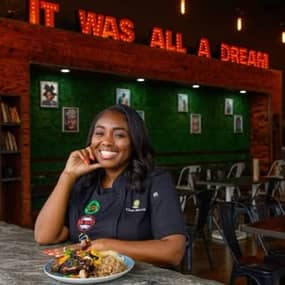
Chef and Owner of The Jerk Shack
Nicola Blaque is the chef and owner behind The Jerk Shack, San Antonio’s only Michelin-recognized Jamaican restaurant. A Jamaican immigrant and U.S. Army veteran, Blaque entered the culinary world after multiple deployments and attendance at the Culinary Institute of America in San Antonio. Her commitment to authenticity has earned rapid acclaim, including media features and numerous awards, while her leadership has helped foster greater diversity and collaboration in the local restaurant community. Blaque’s story reflects resilience, cultural pride, and a deep dedication to shaping San Antonio’s evolving food scene.


